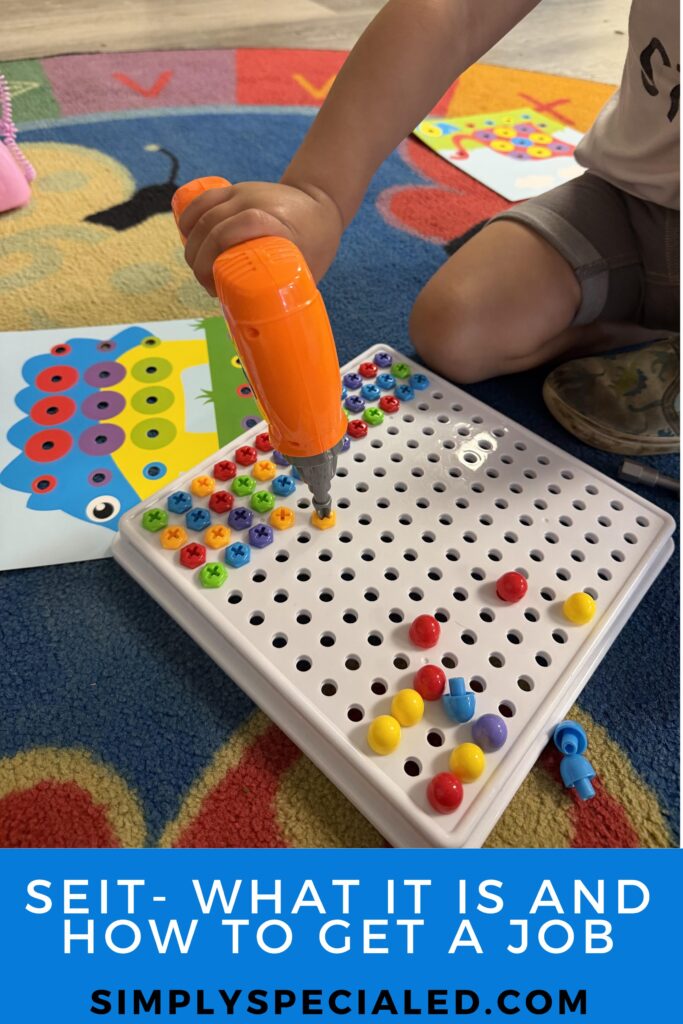
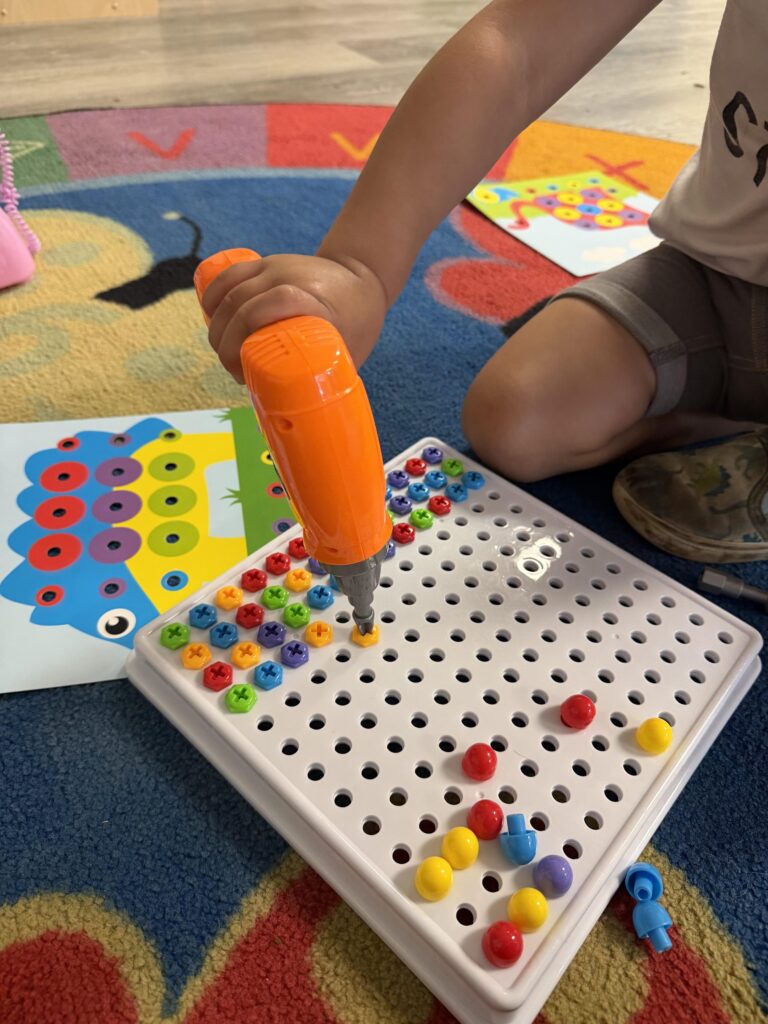
When I was going through my teacher preparation program in undergrad, I assumed that the only thing you could do with a Special Education degree was be a classroom teacher in a school. I thought that there was a set schedule you had to follow. I now know that is not true, and there are many flexible jobs out there, such as a SEIT. Read on to learn what this job is and how to find a job!
What is a SEIT?
SEIT stands for Special Education Itinerant Teacher. Different states may have different terms for this. Essentially, an itinerant teacher is a teacher that travels around to daycares, preschools, homes, community settings, etc. They provide Special Education services for preschool students with disabilities.
I have been a SEIT for almost 2 years now. I see students in different settings and support them through push in support, pull out support, or a combination of both. We work on academic and social-emotional goals. I also write their IEPs, communicate with the families and related service providers, submit progress reports, etc. I have formed many positive relationships with students and families as a SEIT.
Typically, the students that I see are approved for 2 hours per week of SEIT. This may differ depending on where you live. Sometimes, students can qualify for more hours if they have more severe needs. I currently have a student that is approved for 10 hours a week of SEIT.
Push in support
The student’s goals will dictate where and how you provide the support. Personally, my favorite way to provide SEIT services is by pushing into a preschool classroom. I find it easy to work on goals naturally in the classroom. This also allows me to collaborate with their general education teacher.
Examples of push in support
For example, maybe a student’s goal is for them to demonstrate one to one correspondence by counting up to 5 objects. In this case, I would sit with the child while they are playing in a center, completing a craft, etc., and naturally count objects with them. When they are playing in the block center, I may say “Can you help me build a tower of 5 blocks?” I would then count with them as we add the blocks.
They may have a goal of interacting positively with peers. For this goal, I would guide them as they are playing and give them words to use. If I see the child grab a toy from another child’s hand without asking, I will give the toy back and coach my student on how to ask, “can I have that, please?”
I also teach my student that the other child may say no or not right now. In that case, I would set a timer and say “okay, how about (child’s name) can have the toy for 5 more minutes, and then when you hear the timer dinging, it’s time for (my student’s name) to have a turn!” Usually, this type of coaching right in the classroom setting is extremely helpful.
Sometimes, the student may just need some guidance and prompting to follow directions. When the teacher is giving directions to the whole class, I will sit with the student and repeat the directions back, clarify, check for understanding, etc.
These are some ways you can provide push in support as a SEIT.
Pull out support
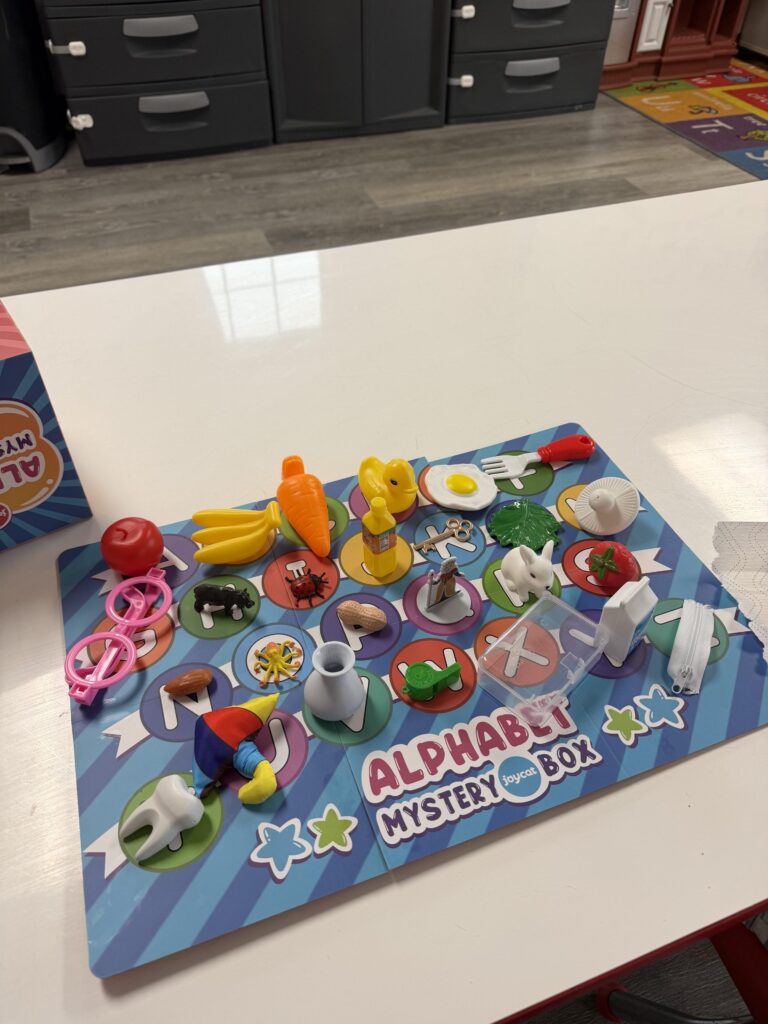
Oftentimes, you will see SEITs pulling students out for their sessions as well. This may look like the SEIT taking the student to an empty classroom in order for them to work in a quieter space. You may also have students that you see at home as well.
When you provide these types of supports, you may need to bring in your own materials (toys, games, craft supplies, etc.) to use with the child. I have visited several daycares/preschools that have a designated therapy space for these types of services to take place.
Examples of pull-out support and sensory play
Most teachers have been kind enough to offer up any of their materials that I may need to use. When I do provide pull out support, I usually play learning/board games with the student to practice taking turns and following directions, etc. We also do crafts, free play, etc.
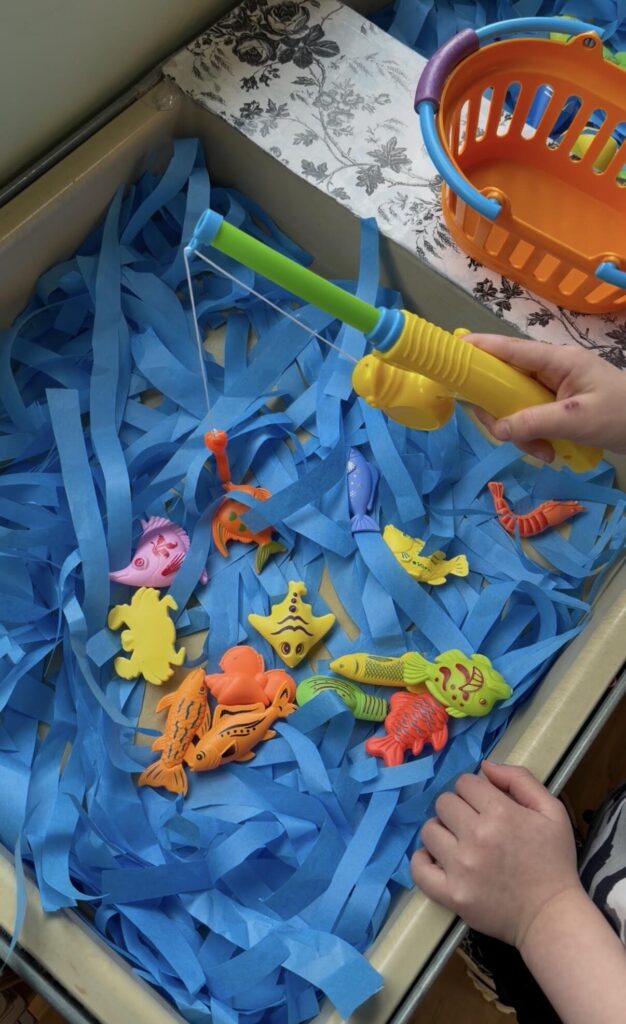
Incorporating sensory play is great as well. I have found it helpful to pull the student to a separate location if I am doing something that might make the other children jealous or distracted. Many of my students love Play-Doh, kinetic sand, shaving cream, etc.
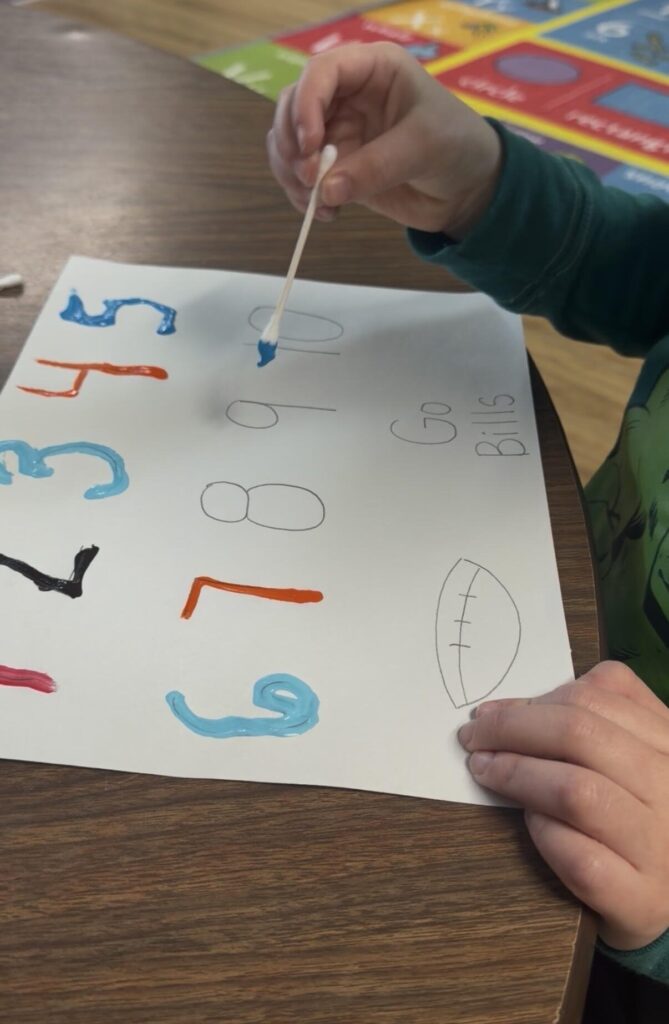
Even something as simple as having my student use a Q-Tip to trace and paint numbers 1-10 (pictured above) can be a great 1:1 activity outside of the classroom. Get to know your students and what they like and dislike. If a child doesn’t like sensory items, don’t force it.
Read this blog post to find out more about sensory play and get ideas for fun weather-related sensory bins.

How to find a job
Finding a job may also depend on where you live and the availability of these positions. I kind of stumbled upon my position by accident! The SEIT position popped up when I was looking for part-time work. When I read the description, I was immediately interested and applied. I did a virtual interview and I got the job!
Being a SEIT is now my “full-time” job. I had 10 students on my caseload last school year.
Some questions they asked were: how do you support students with behavior needs? How do you communicate with families? How do you collaborate? Be prepared to speak on your experiences of working with children with diverse needs.
I am employed through a local agency that provides all types of services for children with developmental disabilities. The child’s local school district will evaluate the child based on the parent’s request, and then once that child is found eligible, the district will reach out to local agencies.
I would recommend doing a google search of agencies that provide these services in your area and look at their career pages. You can also look on sites like Indeed, LinkedIn, etc.
In order to be a SEIT with my agency, you need to have a degree and certifications in Special Education. Because I am certified in Special Education Birth-Grade 2, I am able to provide these services. Check with your state on what certifications they offer.
My agency operates as a first come/first serve basis. So, emails will come through saying there is child x that needs services, the type of services, frequency, location, etc. If you are interested, you respond to the email. If you are matched, you are then given the parent’s contact information and reach out to coordinate a schedule.
Being a SEIT is a rewarding job that comes with flexible hours and a lot of autonomy. If you think this sounds like a good fit, I encourage you to apply! Check out this blog for other ideas on jobs that are not in the classroom if that is something you are interested in exploring.