When learning about behavior management and tracking behaviors, the first thing you will learn how to do is take data. As special education teachers, we need data to back up every decision we make. In applied behavior analysis, this need for data is tenfold. In this post, I am going to teach you the ins and outs of what ABC data is, the best ways to take it and what to do with it once you have it.
Make sure to scroll to the end to grab the FREE ABC Data Sheet.
Let’s start at the beginning:
What is ABC Data?
ABC data is a recording of what is happening before, during and after the behavior. It is also referred to as narrative recording or three-term contingency. When taking ABC data, it is helpful to be as detailed as possible, so that there is little room for subjective interpretation.
What does ABC stand for?
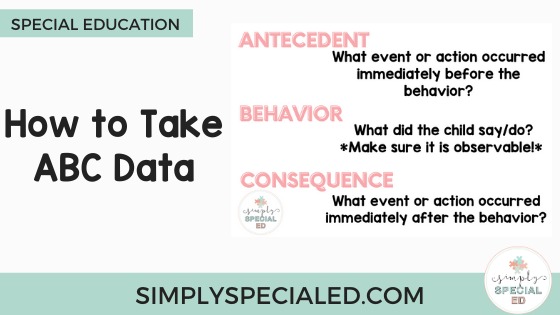
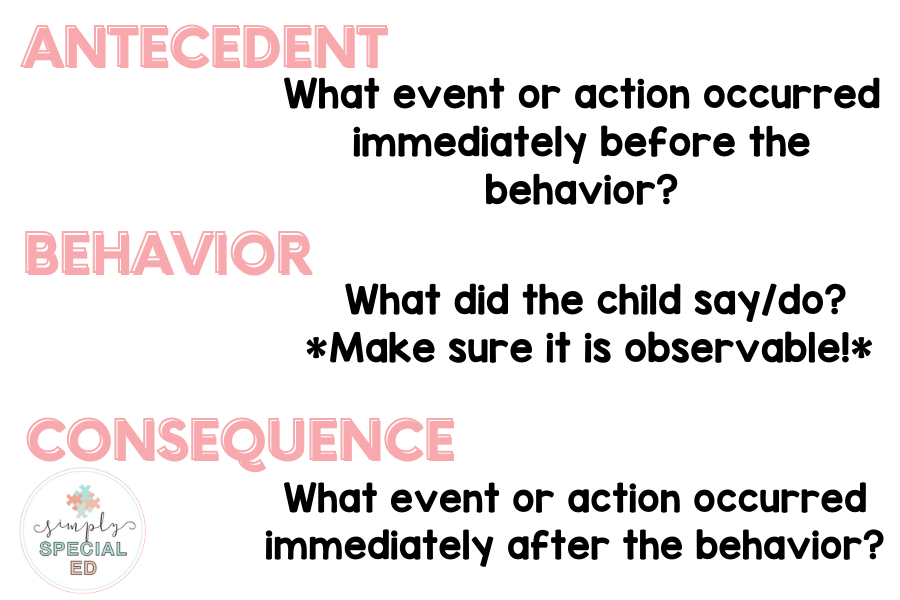
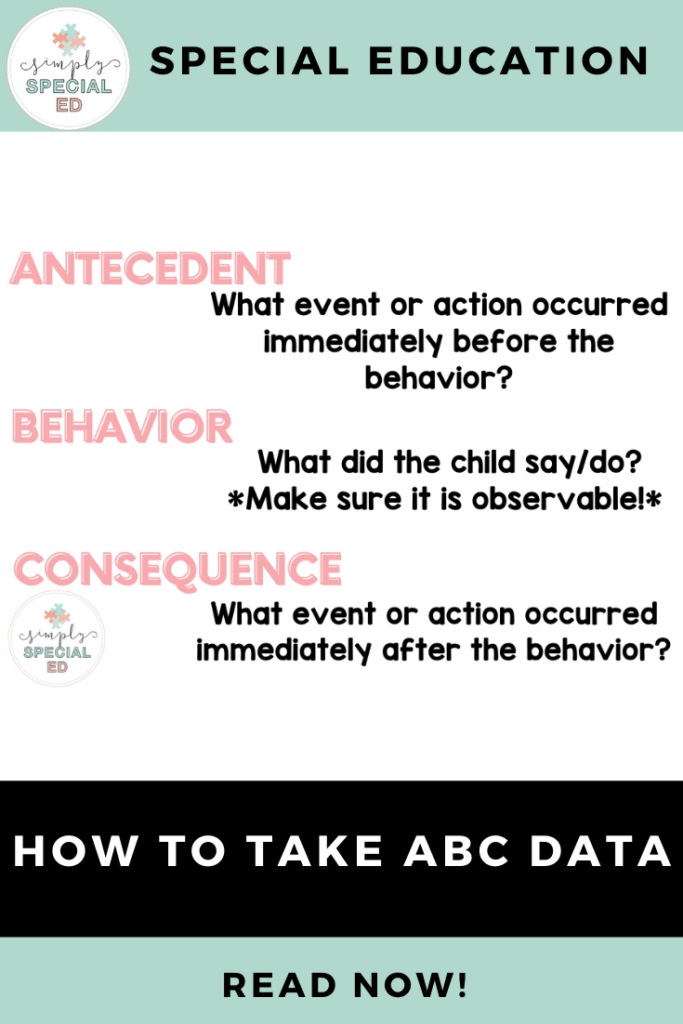
A: Antecedent- what comes before the behavior
B: Behavior- what does the behavior look like, sound like?
C: Consequence- what happens right after the behavior is emitted?
The Three Step Contingency
In applied behavior analysis, ABC data is referred to as the three step contingency. Each step has a relationship to one another and work together to either maintain or change a behavior.
When you begin recording ABC data, you need to ensure that all definitions are operational. When providing operational definitions, you are reporting exactly what you are seeing and hearing. Be sure to avoid words that describe emotions, such as “frustrated”, “sad/upset”, “happy”, etc. Instead, describe how you know that the student is feeling this way (how are they showing that this is what they feel?)
Defining Antecedents
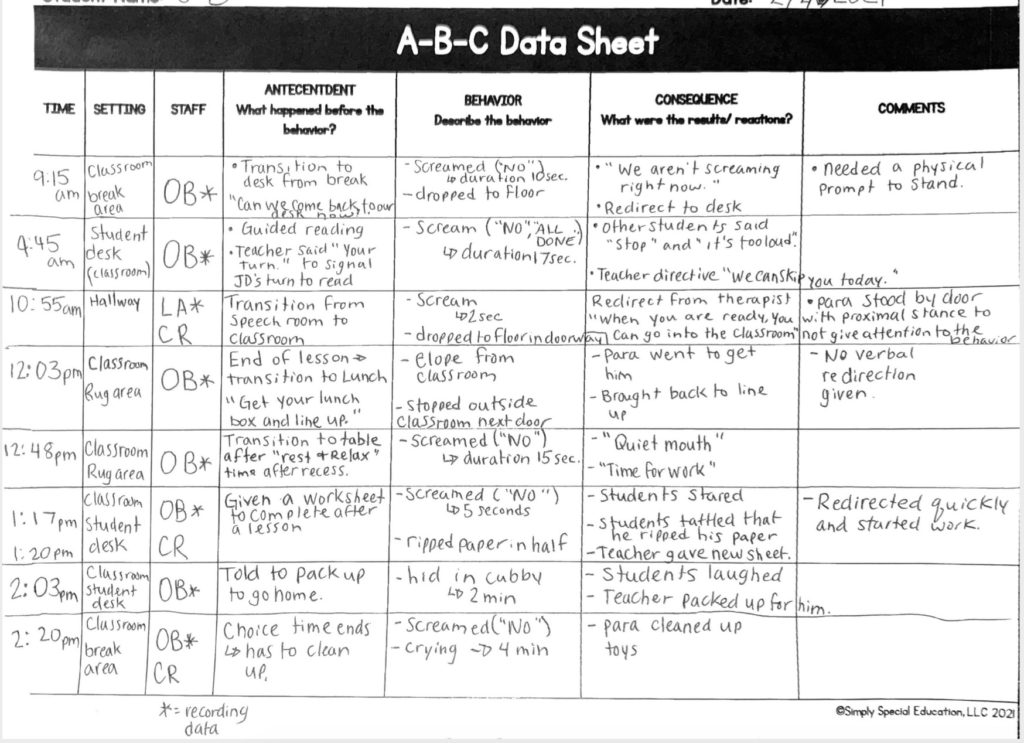
When defining antecedents, record what happens immediately before the behavior occurs. This could be a directive, a transition, or any other disruption in the student’s environment. You should also note who is present in the environment, the time of the antecedent (or the behavior, since you’ll most likely be marking this retroactively) and where in the environment the student is.
If there is a disruption outside of the setting that can impact the student’s behavior (such as forgetting medication or not getting a good night sleep), you will record this as a setting event. A setting event is a more general type of antecedent that can be the undertone of the day’s behaviors.
Defining Behaviors
The word “behavior” is often thought of in a negative way. It is often used to describe what a person is doing wrong. Shift your thinking to define a behavior as an observable and measurable response to stimuli.
What do I mean by this?
Hitting a peer in response to them taking your toy is a behavior. But so is raising your hand and waiting quietly when a question is asked. Behavior can be labelled as maladaptive if its’ consequences are harmful to the student or their peers.
When targeting a maladaptive behavior, be sure to teach a positive replacement behavior that serves the same function. Unsure what the function of the behavior is? See my post about that here!
Defining Consequences
Just like behavior, “consequences” also has a negative connotation. In ABA, consequences and punishment are NOT synonymous. A consequence is simply what happens immediately after the behavior occurs. This can include anything that is said, done or not done in the environment because of the behavior.
An Example:
I stayed up too late on a Sunday night. On Monday morning, I hit snooze on my alarm too many times and am now running late. I miss my usual subway train and don’t get the chance to get coffee before going into school. This is all a setting event. It is happening outside of the environment where the behavior will occur! It will impact my frustration level and patience, but does not directly trigger a specific behavior.
I finally get to my classroom and begin my prep for the day. I make a big pile of papers that need to be photocopied. Right when I get to the copy machine, I realize that there is no paper or toner in the printer. Instead of looking for paper and toner, I drop my big pile of papers into the trash can and walk away.
In this example, having no copy paper or toner in the printer is the antecedent to my behavior. The behavior is dropping all of the papers in the trash can. The consequence is that I waste a bunch of paper and my students do not have work for the day. The function of the behavior is escape; I removed the frustrating task from my environment. A replacement behavior could be asking for help.

How do I take ABC Data?
Now that we understand the components of the three term contingency, we can look at how we record this data. Taking ABC data is recommended when you are observing the reoccurrence of a maladaptive behavior that you would like to target for intervention.
I recommend only taking data on one behavior at a time, so that you can determine the function of that specific behavior. Have more than one behavior you want to track? Start with ABC data for the most interfering behavior and frequency data for the rest.
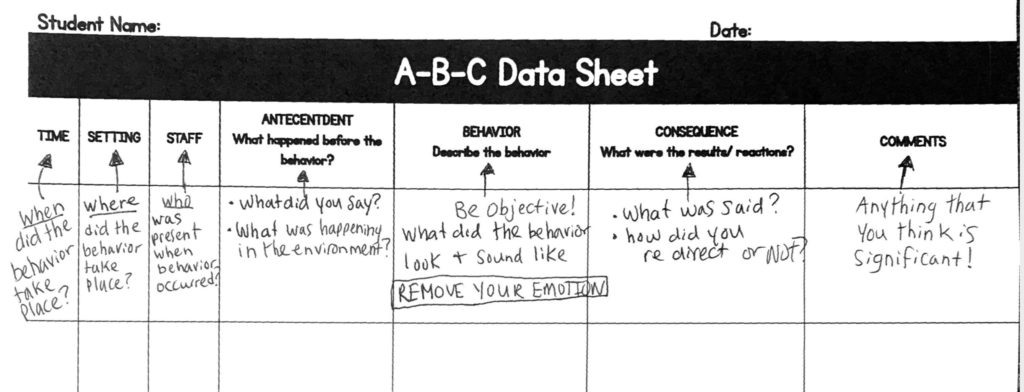
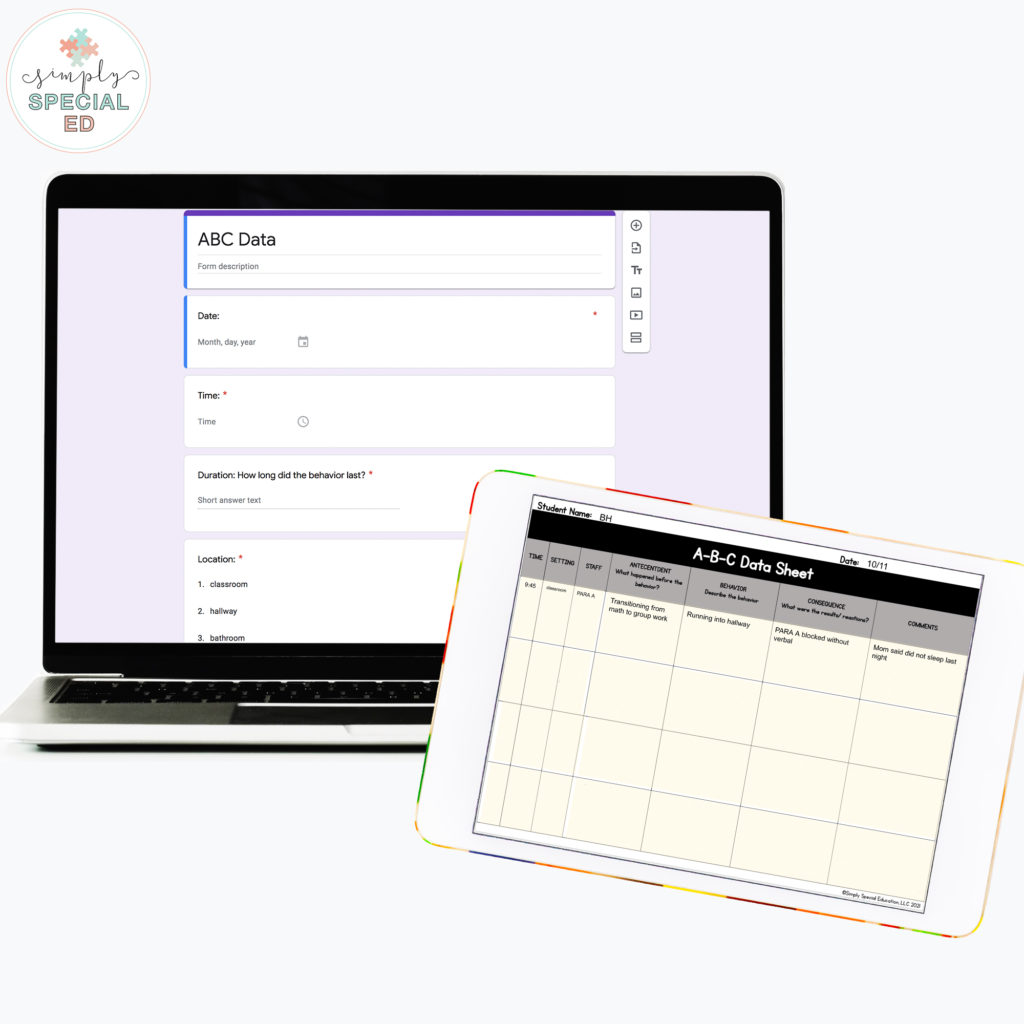
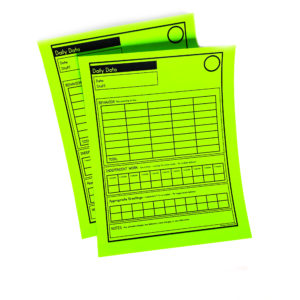
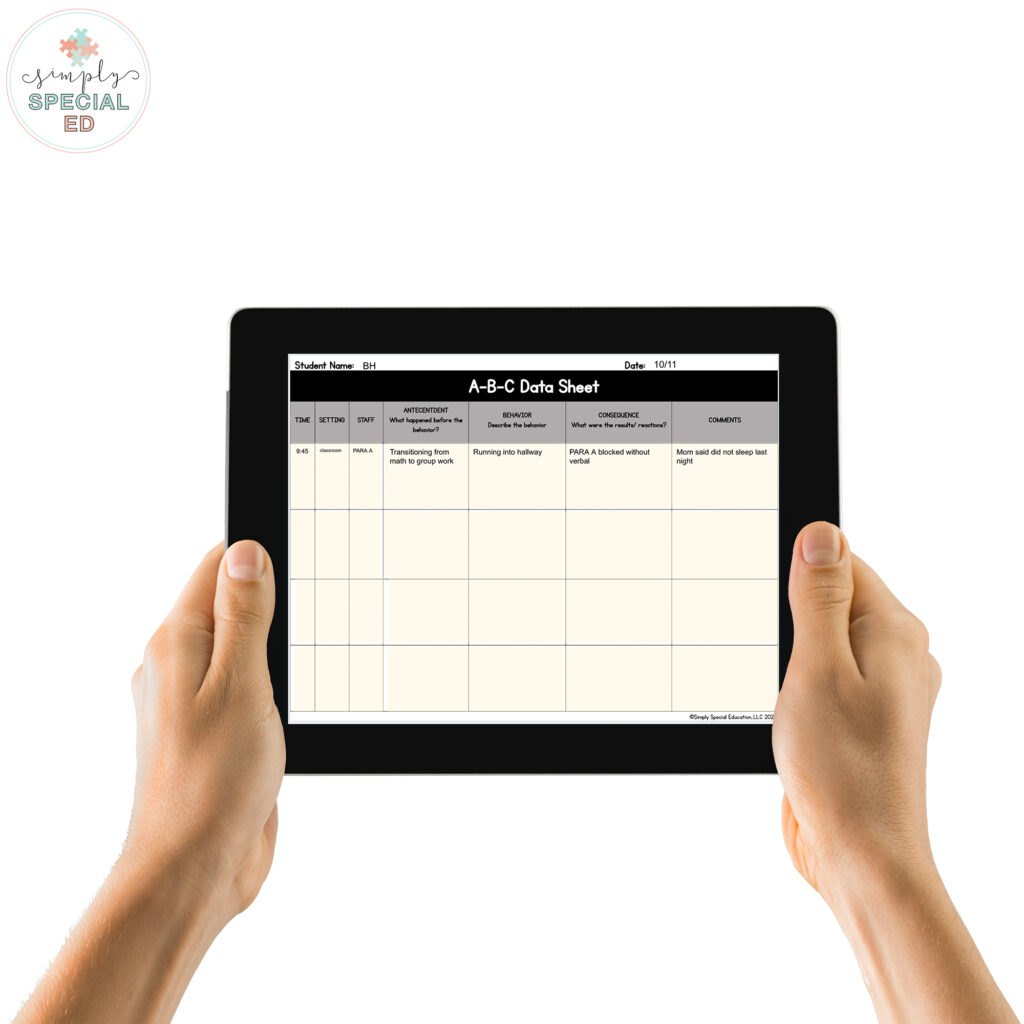
ABC Data can be taken digitally or with a pen and paper. Grab the free set of ABC data sheets here.
How you take the data is your personal preference as an educator. There are great pre-made data sheets, like this bundle from the Simple Free Library!
Taking Data Takes Practice!
The only way to get better at taking and analyzing data is to practice! Is it time consuming? Yeah, definitely. Can it be frustrating? Sure. Do even the best behavior analysts miss something? Absolutely. But don’t let that stop you from taking the data at all. It is better to have some accurate data than no data at all.
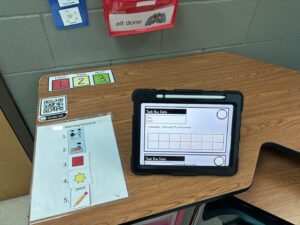
A great way to ensure that data is taken (and is accurate and reliable!) is to get other staff members in your classroom involved. If I am taking behavior data, my paras know what behavior I am looking for and where in the classroom I am keeping my data. That way, if it occurs while I am working with another student, they can let me know what the antecedent and consequence were or they could even write it in the chart themselves! All you need to do is train your staff how to take the data and then you can work together to analyze it.
What do you do with this data once you take it?
You use it to inform your teaching, of course! ABC data can be used to inform a FBA or BIP or any other kind of behavior change program. Once you have the data and analyze it to determine the function of the behavior, you can find an accessible replacement behavior that is not maladaptive but still serves the same function. Questions about this? Work with your school’s BCBA (if you have one) or feel free to leave a comment below!
FREE DOWNLOAD