If you’re new here, I work in an Elementary Resource Room with students with various classifications. Here is an idea of what we do in the Resource Room. Working in an elementary resource room means you see a wide range of behaviors every day. While some behaviors are short-lived and can be developmentally appropriate depending on the age, others can be a bit more challenging. These behaviors can occur frequently enough that they begin to interfere with a student’s learning, peer relationships, or the overall school experience. When that happens, teachers and IEP teams need a deeper understanding of what the behavior actually means. Instead of focusing on what is happening on the outside, we look for the underlying function. This is exactly where a Functional Behavior Assessment (FBA) becomes a very helpful tool. FBA’s are not about placing blame, labeling a child as “difficult”, or used to find an excuse for the behaviors. They’re about uncovering the “why” behind the behavior so we can support the student with strategies that genuinely help. When done appropriately, an FBA can change an entire classroom, creating a more predictable, calm, and supportive learning environment for everyone involved.

What is an FBA in Special Education?
A Functional Behavior Assessment is a data collecting process that is used to understand the function, or the purpose behind a student’s challenging behavior/behaviors. An FBA in Special Education uses data from multiple sources to learn why a behavior is occurring and what the student is trying to get out of exhibiting these behaviors. Most often, communication is the biggest function of behaviors. Students who have difficulties expressing their wants and needs appropriately often engage in difficult or unsafe behaviors as a way to communicate.

For example, a kindergartener who throws materials during writing time may not be “acting out” on purpose. They may be overwhelmed by fine-motor demands, unsure of letter sounds, or seeking attention in the only way they know how. Similarly, a fifth grader who constantly asks to go to the bathroom during reading may not actually need a break, they may be avoiding a task they find frustrating or embarrassing. An FBA helps us uncover these hidden messages, allowing us to respond with empathy and targeted support.

The 5 Steps to Conducting an FBA
1. Define the Behavior Clearly
The first step in any FBA is creating a clear, objective definition of the behavior. This means avoiding vague descriptions such as “noncompliant,” “disrespectful,” or “distracting.” These terms are subjective and can mean different things to different teachers. Instead, focus on what you can see and measure. For instance, instead of saying that a student is “acting out,” describe the behavior specifically. “The student leaves their seat and walks around the classroom during independent writing tasks” is an example. Being specific ensures that every adult working with the child understands exactly what behavior you are measuring and supporting. It also helps you collect accurate data and observe change over time. This step is especially important for younger elementary students whose behaviors may be developmentally appropriate but occurring at a frequency or intensity that impacts learning. With well-defined behaviors, the team can differentiate between typical childhood behaviors and those requiring intervention.

2. Collect Data
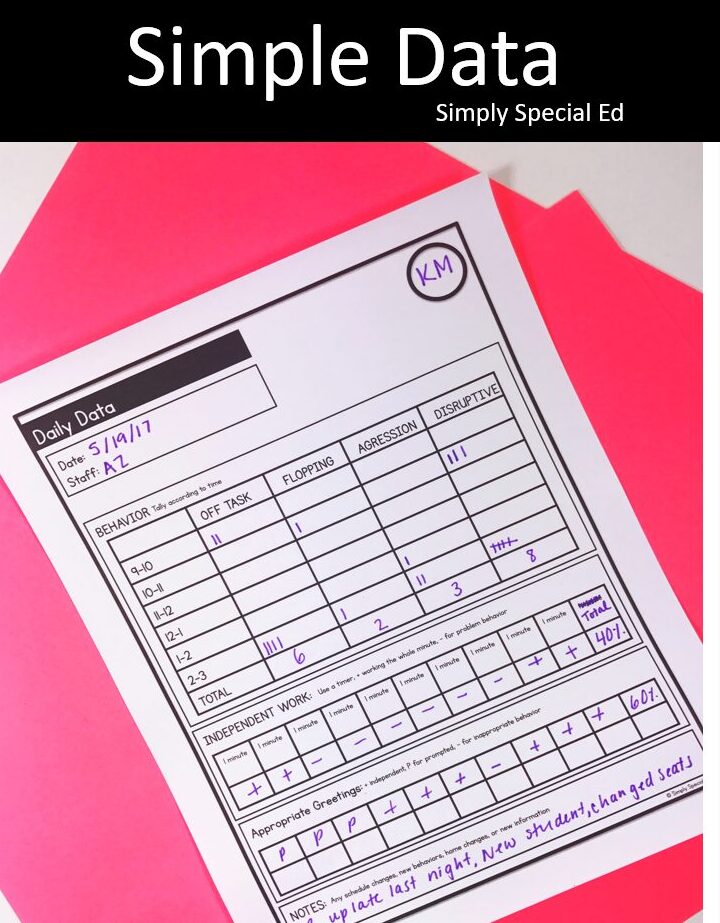
Once the behavior is defined, it’s time to gather the data. This is where resource teachers often play a more important role, because you see the student across multiple settings: the resource room, general education classroom, hallways, transitions, and sometimes specials or recess. The more data you collect, the easier it becomes to recognize patterns that determine the function of the behavior. Data may include ABC Data Sheets (Antecedent–Behavior–Consequence, and the link has a free copy for you to try!), frequency counts, observation notes, work samples, and interviews with both teachers and parents. Each type of data gives you different insight. ABC Data Sheets help identify triggers and outcomes. Here’s a guide on How to use ABC Data Sheets. Frequency counts show how often a behavior occurs. Interviews provide environmental or emotional factors that may not be visible at school. The FAST (Functional Analysis Screening Tool) and the Motivation Assessment Scale are also great tools to use in gathering data to determine the function of behavior.

3. Analyze the Function of the Behavior
After collecting data, the next step is determining the function of the behavior. Here is a guide on How to Calculate Behavior Data. Most student behaviors fall into one of four categories: escape/avoidance, attention-seeking, access to tangibles, or sensory/automatic needs. For example, if a student consistently avoids writing tasks but completes math with no issue, the function of the behavior may be escape or avoidance. In this case, the student may need additional academic support, modified assignments, or explicit instruction in writing skills. If a student calls out frequently during carpet time, the function might be attention, meaning the plan should include reinforcing appropriate ways to gain teacher or peer attention.

Understanding the correct function is crucial to creating a behavior plan. A behavior plan built around the wrong function can accidentally increase the behavior instead of decreasing it. For instance, if a student is avoiding tasks but receives extended breaks after misbehavior, the behavior is being reinforced. An accurate FBA prevents these scenarios and ensures the supports match the student’s true needs.


4. Develop and Implement a Behavior Intervention Plan
Once the team understands the function of the behavior, they can create a Behavior Intervention Plan (BIP). Here’s some more information about data driven support plans. A good BIP does far more than just list consequences. A good BIP outlines a supportive, proactive system designed to teach new skills. For elementary students, this often involves visual supports, explicit modeling, frequent feedback, positive reinforcement, and predictable routines.

The BIP should include strategies to prevent the behavior, such as offering choices, adjusting academic tasks, or using regulation tools. It should also outline replacement behaviors that meet the student’s needs in a more appropriate way. For example, a child who seeks attention might be taught to raise their hand, use a cue card, or ask for help. A child who avoids writing might be given sentence starters, voice-to-text, or shorter tasks. Implementation is key. A plan only works when every adult follows it consistently, across all settings and times of day. Resource teachers often help train staff, monitor progress, and coach classroom teachers on how to reinforce positive behaviors while reducing the undesired ones.

5. Monitor Progress and Adjust
Behavior plans are fluid documents. Students grow, environments change, triggers evolve, and supports need to adapt. The monitoring stage involves regular check-ins with the team to ensure the plan is effective. This may involve reviewing data, observing the student in multiple settings, or meeting with staff to discuss what’s working and what still needs adjustment. For younger students, growth can happen quickly. But, keep in mind that regression can also happen during breaks, major schedule changes, or developmentally challenging periods. Monitoring ensures that supports shift with the student’s needs and that the plan continues moving the child toward independence and success. As the student improves, the team may begin fading supports, reinforcing new skills, and strengthening generalization across school settings.

Tips for Resource Teachers Conducting FBA’s
Resource teachers play a critical role in the FBA process, and your insights often shape the entire direction of the assessment. One of the most helpful things you can do is maintain open communication with all team members. General education teachers may see behaviors you don’t see, and you may see triggers they don’t notice. When everyone shares the same information, the FBA becomes more accurate. Relationships matter, too. Students who feel safe and connected with their special education teacher can be more responsive to support strategies, making it easier to teach replacement skills. Younger students especially need relational trust before they can practice emotional regulation or accept redirection. Prioritizing connection sets the foundation for behavioral growth. It’s also important to remember that behavior is a skill that needs to be taught. Yes, just like reading, writing, and math. Students must be explicitly taught how to communicate, self-regulate, ask for help, and follow routines. Reinforcement plays a huge role in helping students develop these skills, particularly in elementary age students. Celebrate successes constantly and make sure students know their growth is noticed.
FBA’s Supporting Student Success
Functional Behavior Assessments are powerful tools that help educators understand the heart of student behavior. Instead of reacting to behaviors in the moment, an FBA empowers teachers to respond proactively, empathetically, and effectively. For elementary resource teachers, these assessments are especially meaningful because you’re uniquely positioned to notice patterns, build relationships, and support students in small-group settings where behavior becomes easier to understand. When schools use FBA’s intentionally and consistently, students experience more success, teachers experience less frustration, and the entire school environment becomes safer, calmer, and more supportive. At the end of the day, the goal isn’t just to reduce challenging behavior, it’s to build students’ confidence, teach lifelong skills, and help every child access learning in a way that feels manageable and meaningful. For more information on data collection, check out these great resources! The Special Educators Guide to Data Collection 10 Must haves for Data Collection