Hi there! Centers can seem daunting for any classroom. But, they are especially daunting for a special education classroom with many challenging behaviors. I will go over a few activities that you can do that work well in centers for those with challenging behaviors. I will also review some tips and tricks for doing activities in centers with challenging behaviors.
Adapted and Differentiated Worksheets
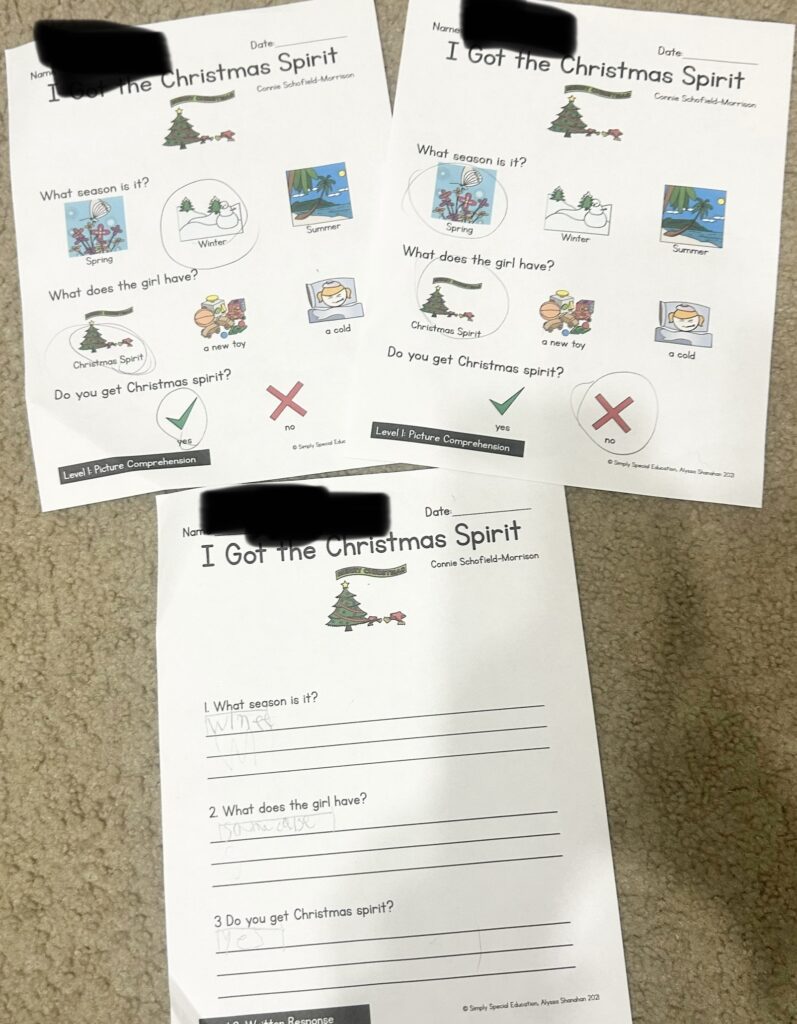
Now, this is probably our least favorite option for students with challenging behaviors, but let’s look at ways that we can make it happen. We all need at least some worksheets for our students, but how can we make them behavior-friendly? Let’s start by adapting and modifying the worksheet to the student’s instructional level. One reason we may see behaviors is that the students do not understand what to do or how to do it. We have 2 choices. One is that we can completely modify the work to change WHAT work they are doing as compared to their peers. Or, we can adapt the work to change HOW they are doing the work that is the same as their peers.
An example would be a comprehension worksheet about a story about Easter that was read to the whole class. The original worksheet may be 10 questions long about the Easter story. To modify the work, one student may have to complete drawings about what they saw in the book. To adapt the work, one student may have the 10-question worksheet with visuals and only 2 questions per page. The image below shows another example using an SSE activity. The students had the same work, but the student from the top right pointed to the correct answers, and I circled them. The student at the bottom wrote in her answers instead of circling.
Another way!
Another way to adapt the worksheets for our behavior students is to allow them choices in their work. If the target is to complete the worksheet, then allow them to choose the writing utensil they use. They may also choose what type of chair (or no chair) they sit in to complete it. Maybe the worksheet says to circle the correct answer, but they want to draw a butterfly next to the correct answer. As long as the student completes the worksheet, then allow them to adapt it to their preference, and you will still reach the same end goal! For more information on differentiation, check out this blog post!
Independent Work
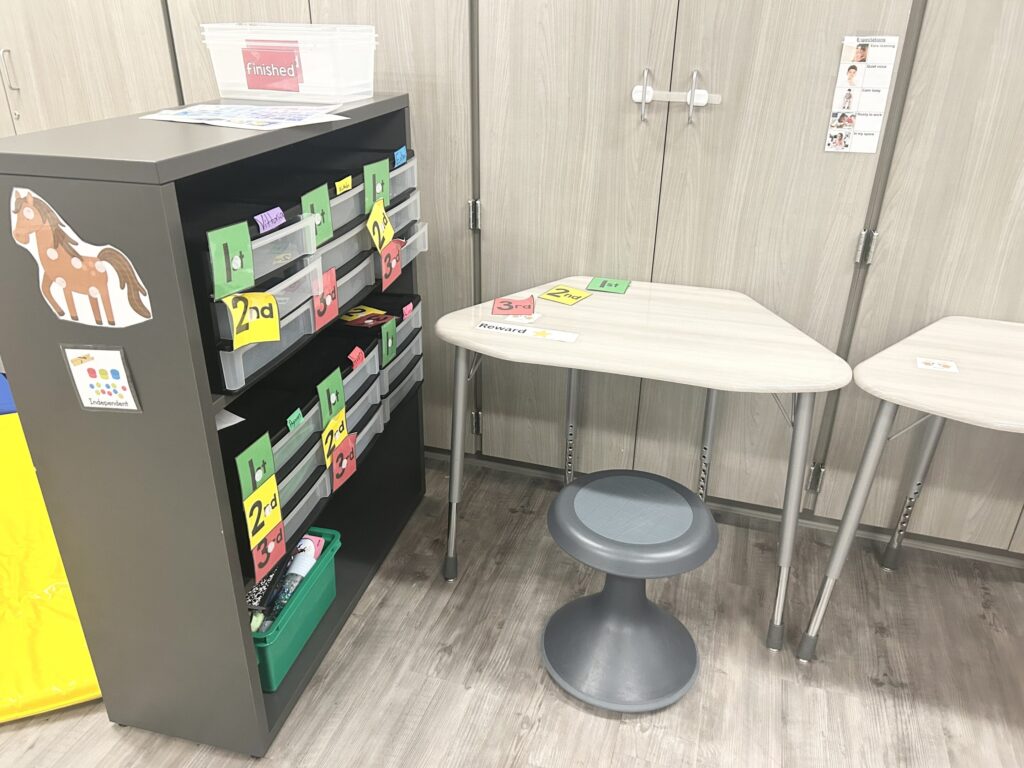
Setting up independent work for our students is going to take some proactivity on the teacher’s end, but it is worth it once it is set up. Independent work can be done through task boxes, work stations, independent work binders, etc. This should be work that your student has already mastered, so they can do it fully independently. Every student can do something independently, even if it is difficult to find.
As shown in my picture below, I have a 3-drawer independent work system set up as a center rotation for all students. I spend time at first explicitly teaching and modeling how to go through the steps independently. Some of my lower students do all 3 errorless tasks, but they are still able to sit and complete 3 tasks. Independent work can help our students with challenging behaviors because the work is already mastered, the station is predictable, and they have a sense of autonomy over their work.
Learn through Play
This definitely seems like an early childhood idea, but it works for our special education students as well! This one is great for our students who don’t like to “work,” but they still have academic goals to meet. Beforehand, manipulate and pick out the “play” items that the student can choose from in centers. These items will be items that can be used academically as well. For instance, during math time, when working on counting, building blocks could be an option at a center to count. Another example might be during science time, when working on 5 senses, fidget pop its and snacks can be available to talk about touch and taste. The important thing about learning through play with students with challenging behaviors is to plan the “play” items appropriately (but still giving options) to their goal or the lesson at hand.
Learn through Play contd…
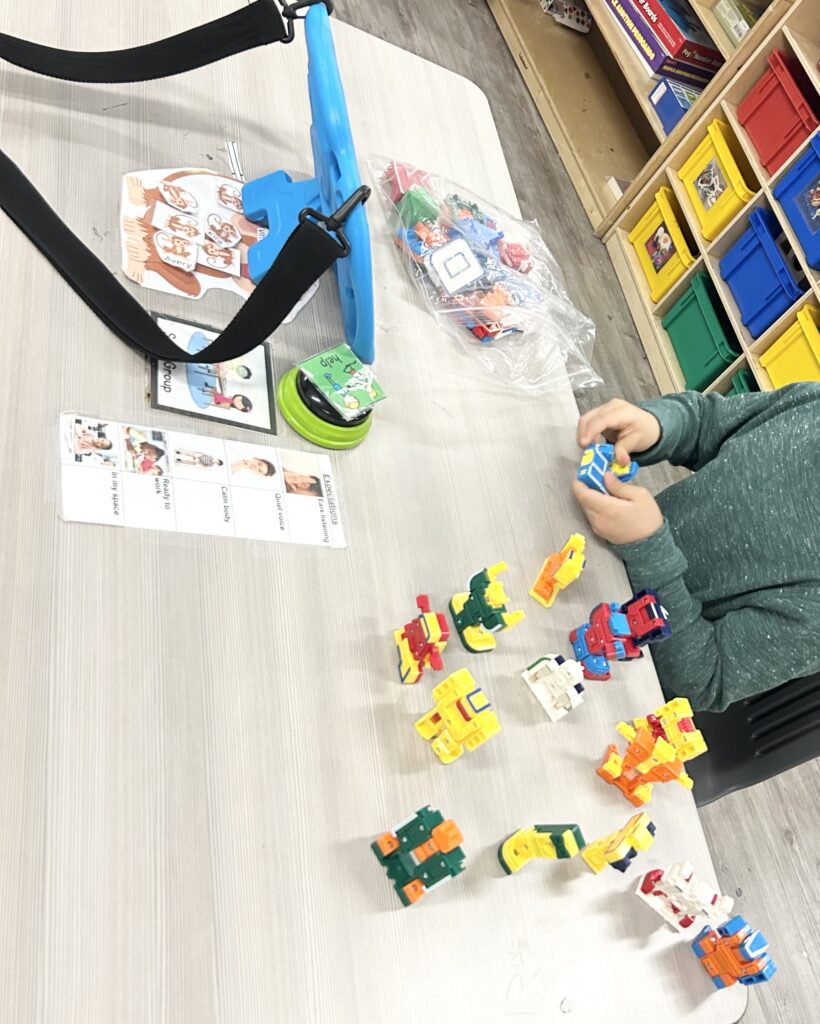
MOST important is not to make it seem like work to the student. Don’t give them strategic toys per the lesson, then sit and ask them lots of academic questions. They will know right away that they are working, and you might start seeing challenging behaviors. Let them play, and you join in on the play! Model casual play while throwing in some academic vocabulary. Talk about what you are doing and what you see them doing, but reduce the demands and questions. You will be surprised by how much your students will learn by engaging in “academic play!”
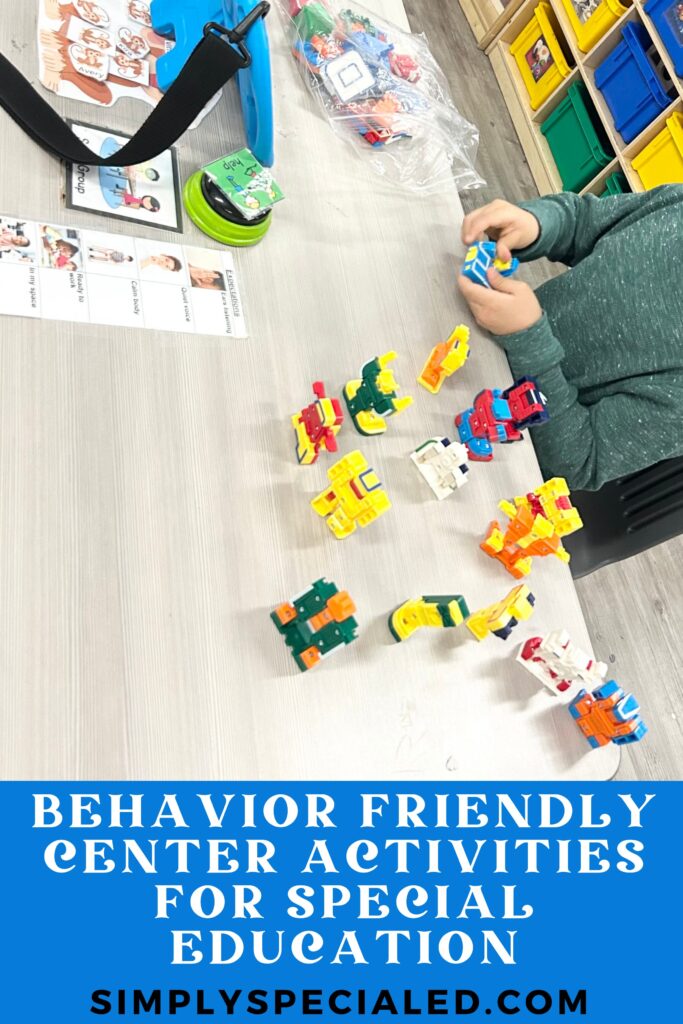
The picture below shows a student in my class playing with alphabet letters that turn into robots. The student is working on letter recognition, so I sat beside him and modeled the letter names each time he pulled them out of the bag or played with one, but I never made him say them or identify them on his own.
Incorporate Interests
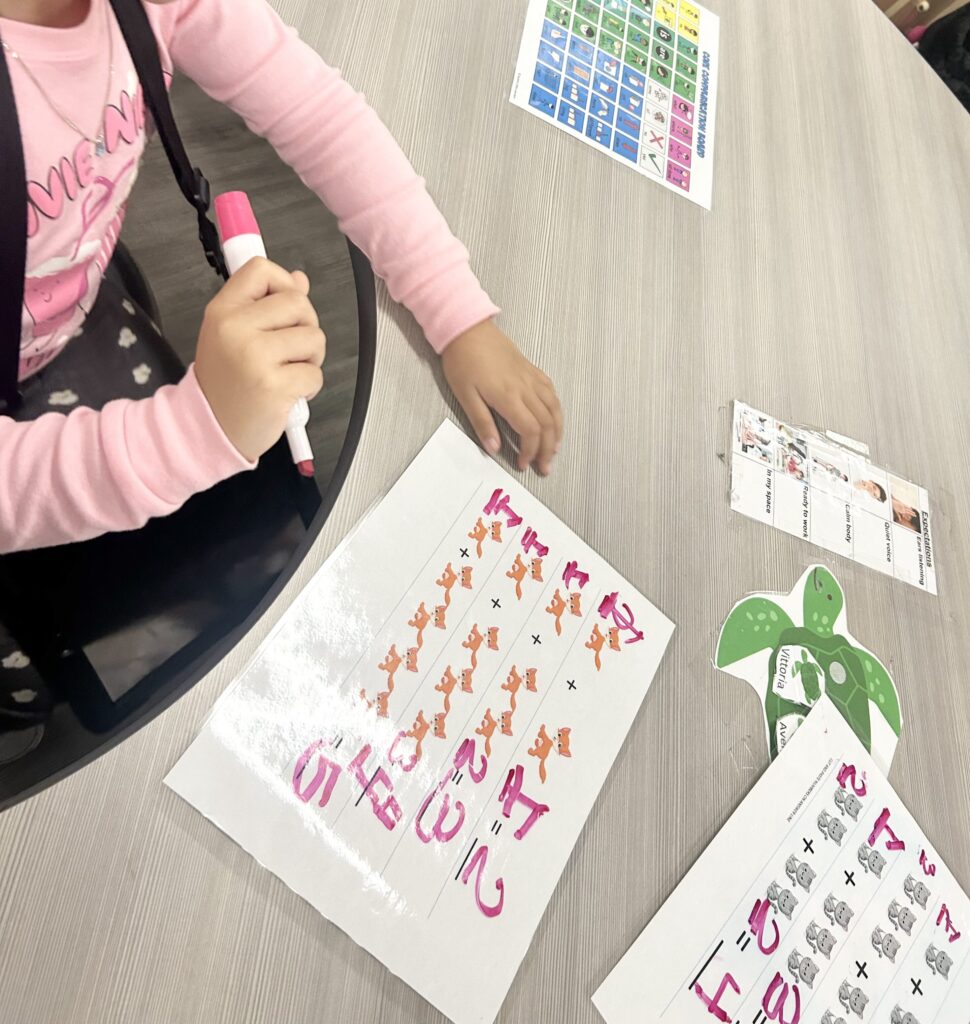
The great thing is that incorporating students’ interests can be used throughout each paragraph topic discussed here! Find what the student likes, and don’t wait to only use that as reinforcement. Use that in the student’s work! Now again, this may take some planning on the front end, but it will be worth it when we see a decrease in center behaviors. The picture below shows a student learning how to add using cats, and she loves cute animals! I started teaching her addition with basic addition worksheets using shapes as counters, and she immediately went into behaviors. I scratched that idea, and I laminated some addition worksheets on the same topic that match her interests! She has now almost mastered the goal of adding using visuals!
Positive Reinforcement
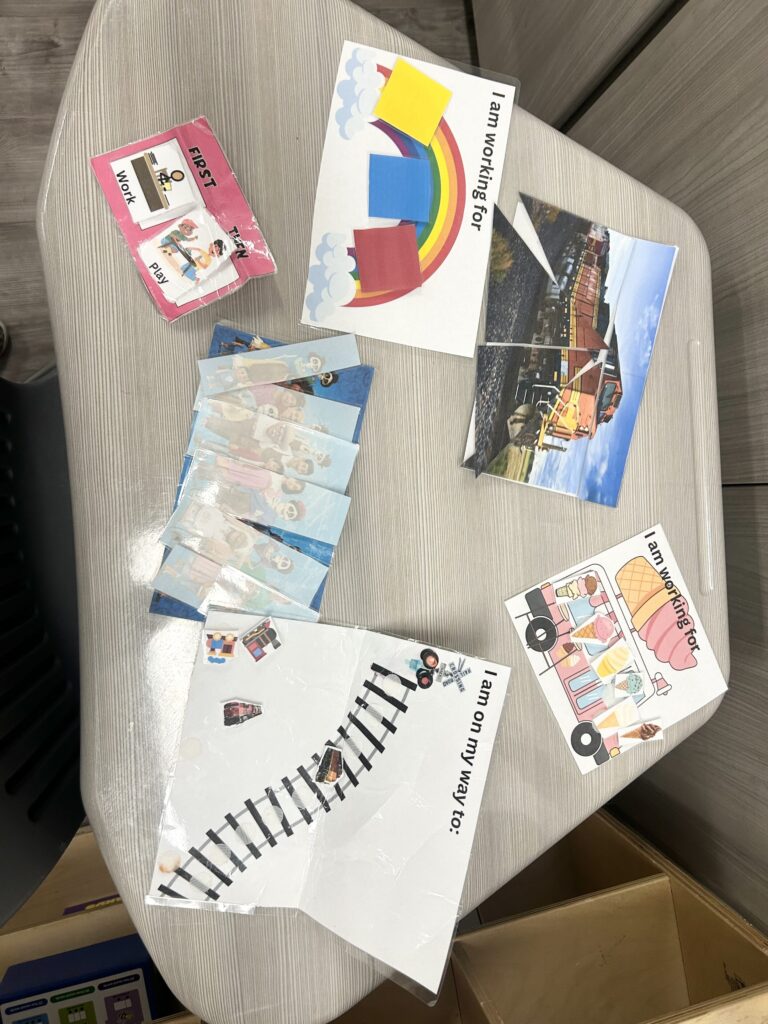
A special education teacher’s most-used technique is probably positive reinforcement. This can be seen in many different ways, as long as the teacher rewards the desired behavior to increase it. A token board or first/ then chart is a great way for a student to see how long until, and what they have to do to reach the desired reinforcement. You can also incorporate a student’s interests in the token board, so they are receiving positive reinforcement each time they put a token down as well!
The important thing to remember about effective positive reinforcement for students with challenging behaviors is that the reinforcement has to be highly desired. If a student is not motivated by the iPad like his peer, then saying “first work, then iPad” will not decrease their behavior. Take some time to find what really motivates the student, then use that as positive reinforcement.
The reinforcement also has to match the behavior and its function. For example, if a student is exhibiting behaviors that are maintained by the escape function, then their first/ then may be “first work, then take a break on the bean bag or take a walk outside.” Find the function of the behavior. Find what they are motivated by. Then, utilize that motivation to find the appropriate reinforcer that matches the function. To understand more about the functions of behavior, check out this blog I previously wrote. Below are some different types of token boards that I have made. You can check out this link to find some premade Simply Special Ed token boards!
Conclusion
Whoo, that was a lot! Centers can be daunting to start and maintain for our students with challenging behaviors. Don’t forget to differentiate worksheets appropriately, learn through play, incorporate interests, and utilize appropriate positive reinforcement. I hope you can use some of these in your centers’ activities to help decrease behaviors in centers.