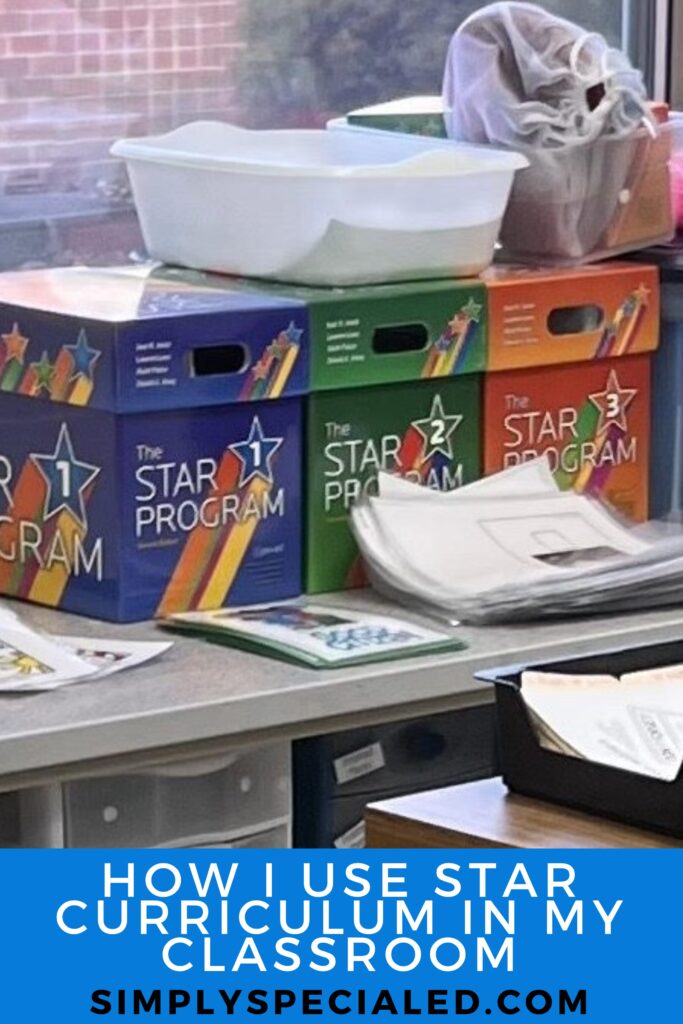
I have been very fortunate in my teaching career to have access to many different curricula. In my own classroom, I have seen so much success and progress in my students using the STAR curriculum. I began using STAR when I was student teaching. It was great to have hands-on experience as I was learning how to teach. I then recommended it to my school, and my colleagues and I attended the 2-day training. Since I had access to other curricula, I’m going to explain how STAR worked for my elementary classroom!

Assessment
At the beginning of each school year, I assess my students’ skills using the STAR Profile. I compare it to the previous year if they already have one. This helps me plan out which lessons to teach. The areas for assessment are shown above: receptive language, expressive language, pre-academic/academic concepts, play/social, and functional routines. I collaborate with my SLP and Social Worker for areas of language and play/social.
Organization
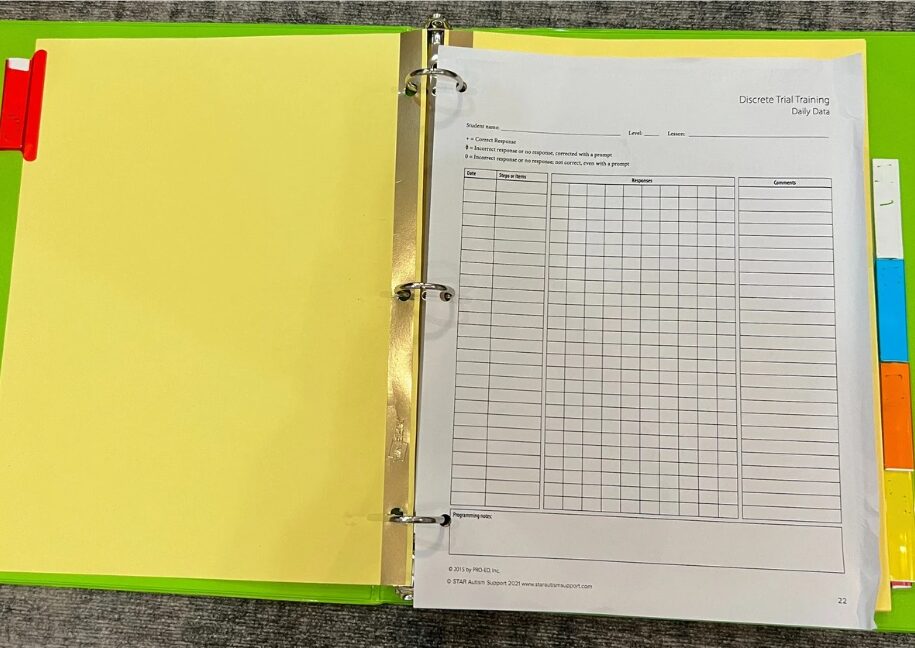
I create a binder for my whole class rather than creating a binder for each student. This works for me because I only have about 6 students in my classroom. Often, they are also working in the same lesson. This allows me to store the materials all in one binder rather than searching through multiple binders and the kits. I create a tab for each student and use sheet protectors in front of each data sheet. Typically, I work on 3 lessons at a time per student (3 data sheets and 3 sheet protectors per student). I store the picture cards in the sheet protectors that correspond with the lesson. If you’re needing help getting a binder organization system in place, check out How to Organize Data for IEPs.

Teaching the Lessons
I always teach STAR discrete trials or (DT) during my center rotations. Each center block, I alternate between teaching IEP goals and STAR lessons. I keep a STAR bin at my table that holds all important materials, such as extra data sheets. This helps so I don’t have to run to the copier during a lesson. For reinforcing correct responses, I use a token board, which is the STAR protocol. I have a bin of reinforcers at my center for when students earn their reward. In my own classroom, I feel that 3 lessons per student is manageable. I follow the STAR scope and sequence of each lesson so that I know exactly what lesson to teach next. STAR also has a distinct data collection protocol as shown above. This lesson is from the imitation lesson. Each + means the student responded correctly, and the o with the line means they required a prompt.

Additional Activities
STAR has additional activities other than DT (Discrete Trials) like PRT or Pivotal Response Training. You can create a center that works on PRT and include your SLP and/or Social Worker. They also have a variety of online activities under their “theme first” tab. These activities include academic areas, such as reading, math, science, and social studies. It also includes life skills and circle time activities. Since the STAR discrete trials are based in a 1:1 setting, the online activities are great to use for whole group time! There is also a category for file folders underneath the academic areas. I use these for independent work and laminate, velcro, and cut them out so they are reusable! This is super easy to do! I now have themed units for each month so students don’t get bored of the same activities.
STAR can seem overwhelming to begin in your classroom. Once you break it down by each part, it becomes second nature. Each lesson is set up with very similar data criteria and mastery, so you may be teaching new skills but doing so in the same format. I hope this helps to make it easier for you to get started in your classroom!
If you’re interested in teaching STAR in your classroom but don’t yet have it, check out this blog post on How to Get Funding for Special Education Curriculum!