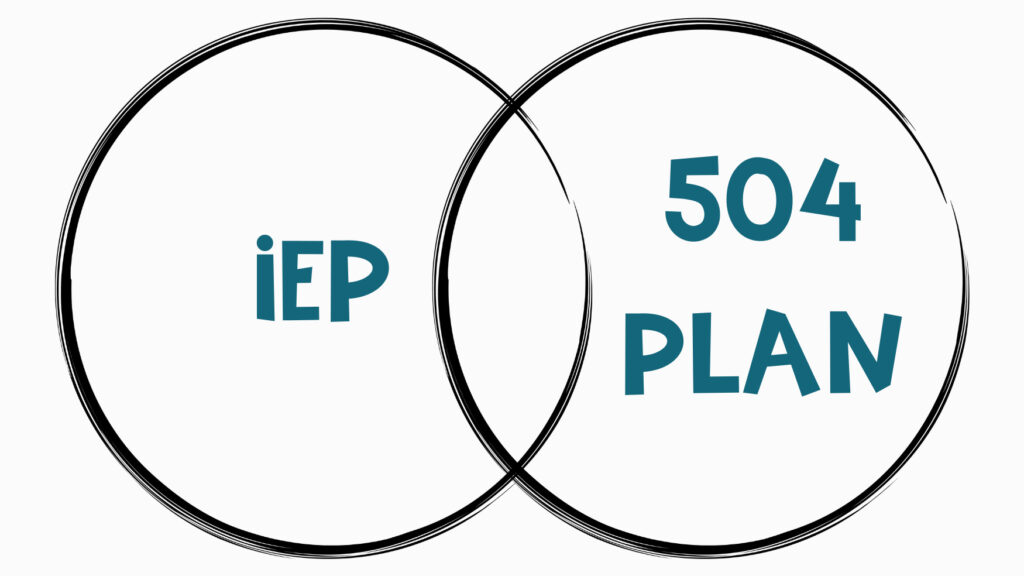
Despite having been a special education teacher for years, I still find myself being confused about the differences between an IEP and a 504 plan at times. Both plans aim to support students with disabilities. However, more specifically, an IEP focuses on educational benefits through specialized academic instruction (aka special education), while a 504 plan ensures the student has equitable access to their general education learning environment. Nonetheless, both plans are similar in some ways but different in others. Let’s dive into their differences below.

What is an IEP?
IEP stands for Individualized Education Program or Individualized Education Plan. An IEP is a legal document that lays out specialized instruction, supports, and services a student with a disability needs to thrive in their least restrictive environment. An IEP is the foundation of special education.
IEPs are part of the Individuals with Disabilities Education Act (IDEA), which governs special education. Under this federal act, schools must provide appropriate specialized instruction and related services to all eligible school-aged children with disabilities, regardless of the disability or level of severity.
What is a 504 Plan?
A 504 plan is a formal, written document that schools develop to outline the support that a student with a disability needs to learn alongside their peers. These supports could be accommodations, which are changes to the learning environment to remove barriers to learning. A 504 plan is not part of special education.
A 504 plan is covered under Section 504 of the Rehabilitation Act. This federal civil rights law ensures that an individual is not discriminated against due to their disability.
If you want to dive deeper into what a 504 plan is, read my blog post here.

Who is eligible for which plan?
School-aged children, aged 3-21, who meet the following two requirements, may be eligible for an IEP:
- The student must have one or more of the 13 disability categories listed in IDEA.
- Additionally, the student’s disability must have an adverse effect on their educational benefit from the general education curriculum. In other words, the student needs specialized instruction to make progress in school.
Note that an IEP is only for PreK-12 students. An IEP is no longer valid once a student graduates from high school. A 504 plan, on the other hand, is valid even in college.
To be eligible for a 504 plan, students have to meet the following two requirements:
- The student needs to receive a diagnosis of a disability. The disability does not have to fall under one of the 13 disability categories listed in IDEA.
- In addition, the student’s disability must substantially limit one or more basic life activities, which interferes with their ability to learn in a general education classroom.
What is in each plan?
IEPs must include the following major components:
- Review of assessment reports and eligibility statement (if Eligibility Evaluation)
- The student’s present level of academic and functional performance
- Review of previous goals and proposal of new annual goals
- Related services that the student needs to support the goals
- Classroom accommodations and modifications
- Statement of how the child will participate in standardized tests
- Offer of free and appropriate public education
- Statement of transition (beginning at age 14)
Unlike an IEP, there are no specific requirements for what needs to be included in a 504 plan. However, 504 plans typically include the following:
- Accommodations for the student
- Names of who will provide each service
- Name of the person who is responsible for ensuring the plan is implemented with fidelity

What is the review timeline?
IEPs are reviewed annually. Additionally, the student is evaluated every three years to determine whether special education services are still needed.
The timeline for 504 plan reviews varies. Typically most states review the plan every three years. 504 team members have the right to request a meeting to discuss the plan more frequently as needed.
Conclusion: IEP VS 504 Plan
All in all, both IEPs and 504 plans provide benefits for supporting students in their path toward educational success. Depending on your learner’s needs, an IEP or a 504 plan may better serve them. I suggest connecting with your student’s educational team if you have concerns about their access to educational success.


FREE DOWNLOAD
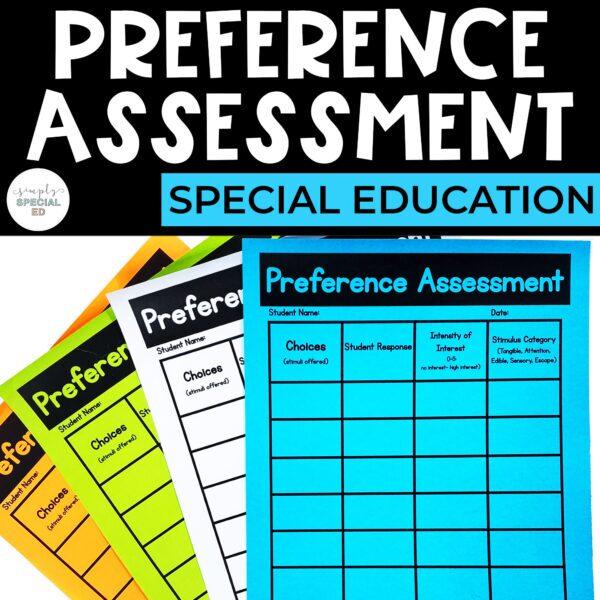
Use this FREE preference assessment to learn about student interests to include in the IEP! This helps for a more well rounded IEP should the student ever leave you or your district. This is a free download!