In school-based occupational therapy (OT), caseloads can be quite large [see my blog on how to prep for a new school year with high numbers!]. One beneficial strategy to temper this challenge and make the workload more manageable, it to consider utilizing pre-referral strategies. Rather than going right to an evaluation for all students who are referred, pre-referral strategies empower teachers/parents to support mild delays/needs without special education support.
Occupational Therapy Evaluation Process

For some background, occupational therapy is a related service in the schools. Per the Individuals with Disabilities Education Act [IDEA], occupational therapy [among others] are “developmental, corrective, and other supportive services as are required to assist a child with a disability to benefit from special education” [IDEA Sec. 300.34]. Therefore, students need to be receiving special education services to have OT as a related service. Depending on your state and district, students may be able to qualify for OT support via 504 Service Agreement. However, prior to formally evaluating a student, my district encourages the classroom teacher to trial some strategies in the least restrictive environment (LRE). While there are SO many types of strategies that would could discuss, I am going to highlight some of my favorites below based on the most common referrals I get at the elementary school level.
Handwriting Pre-Referral Strategies

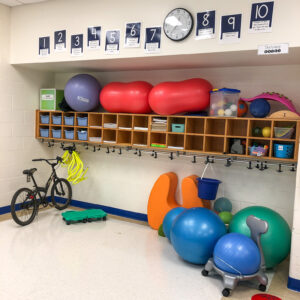
Handwriting delays may be due to difficulty with hand strength/endurance, pencil grasp [especially in younger grades], or fine motor precision/control. Our OT department wrote a grant last year [learn about it on this blog] for the hand strength bins shown above. We often offer these to students who seem to have fine motor weakness, early fatigue, immature grasp, etc. I share about other fine motor strategies in these blogs:
Fine Motor Concerns for Handwriting
- Practical Pencil Grasp Tips for Teachers
- Small writing utensils, pencil grippers, adapted pencils, etc.
- Writing on a vertical surface like a slant board to promote proper positioning [see Taylor’s blog]
- Blog Series on Pre-Writing Skills
- Development of gross motor skills prior to building fine motor ability
- Strengthening fine motor skills
- Incorporating multi-sensory pre-writing practice
- Learning to write through daily practice of a developmental sequence for letter formation

Visual Perceptual Concerns for Handwriting
Handwriting delays may be due to difficulty with visual perceptual skills. Keeping letters on the line or within the space provided can be challenging for students. Scanning textbooks to copy notes or copying from the board is often a challenge. Beyond ruling out medical-based vision concerns and ensuring proper positioning [discussed above]. Pre-referral strategies may include:
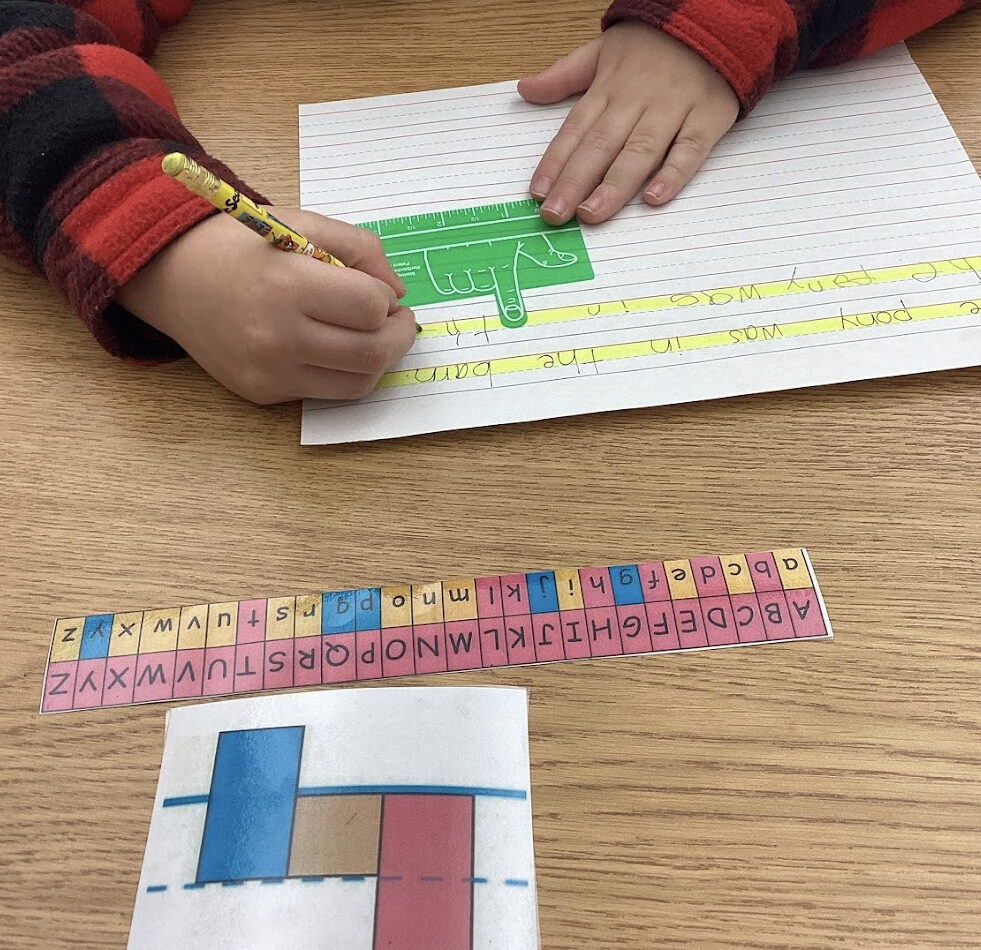
- Utilize adapted paper such as Bright Lines Paper, Redi Space paper, graph paper or raised baseline paper
- Introduce a spacing manipulative or use of a finger to space between words
- Ensure student has received instruction on letter sizing
Scissor Skill Pre-Referral Strategies
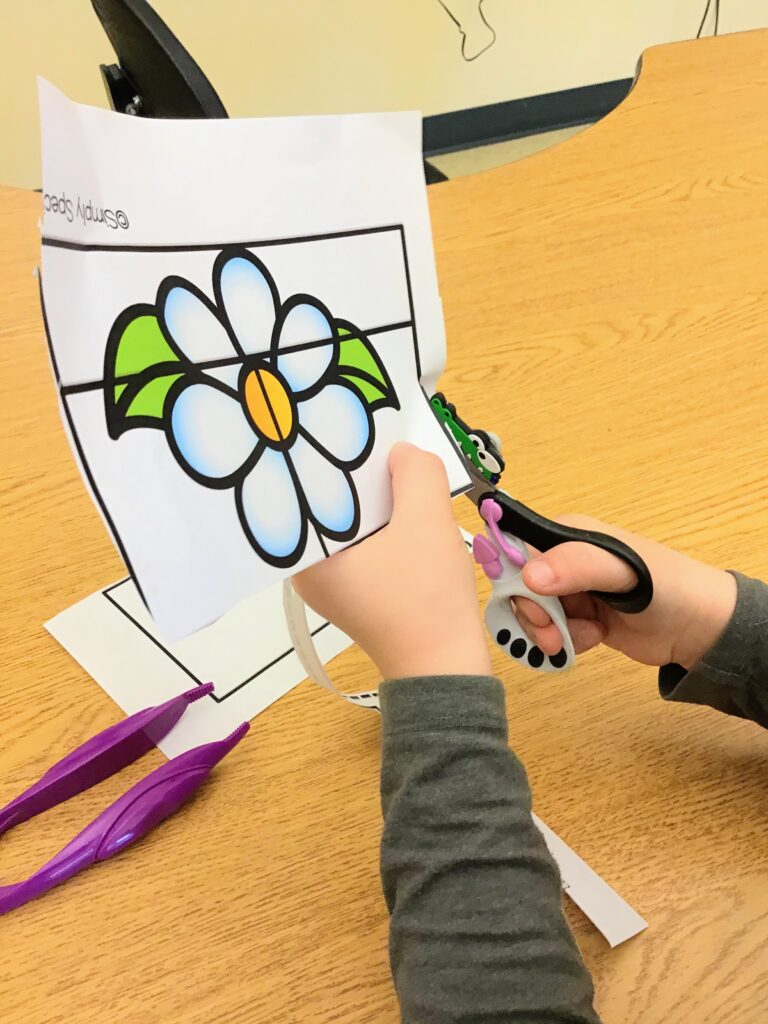
Cutting is a challenging skill that incorporates visual processing skills, visual motor skills, fine motor control, motor planning, bilateral [2 handed] coordination and much more! These pre-referral strategies may just do the trick to support students who are struggling with scissor skills:
- Build pre-scissor skills with tongs/tweezers
- Highlight or bold the lines to increase the visual contrast
- Use adaptive tools like spring loaded or loop scissor or Hungry Cutters
- Put something under the elbow of the dominant hand to encourage non-dominant hand use for paper manipulation
Sensory Pre-Referral Strategies
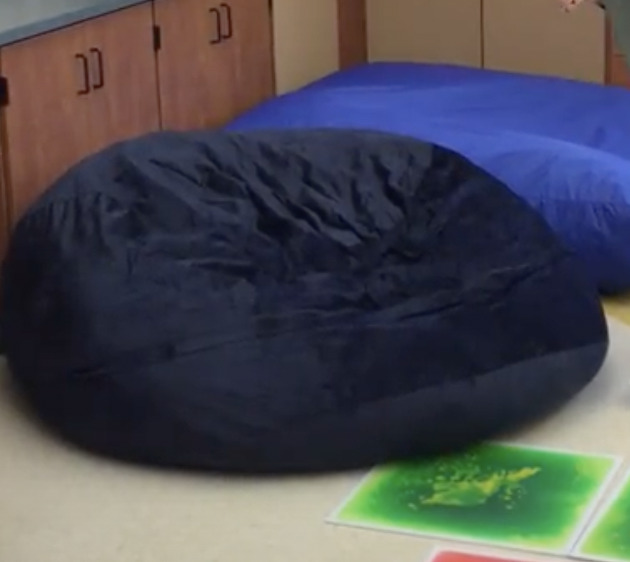
This is a tricky topic that could be a blog in and of itself. If you are hoping to have an individualized “sensory diet” for a student, an OT evaluation is necessary. The individual sensory needs of a specific student should be formally assessed by an OT before interventions are implemented. I have blogs regarding classroom strategies for sensory seekers once it is determined what the needs of the child are. A basic strategy that might benefit the whole classroom could be the FREE Simply Special Ed Movement Break Cards. Get these movement break cards for FREE HERE!
School-based OTs are a wealth of knowledge in a variety of areas outside of those discussed above. I encourage you to reach out to your school’s therapist to see if your concern area can be addressed [either formally or informally] but your OT!